Tradie Website Index 2026: 3 in 4 tradie homepages failed our phone check
 Pat FongFounder, ServiceScalePublished 9 November 2026 · 10 min read
Key takeaways
- By Pat Fong, ServiceScale.
- When I ran a trade business, most of our work came from referrals and word of mouth.
- Every figure below states its base.
- We captured exactly what shows on the first screen of a phone, 390 pixels wide, before any scrolling, and checked two things: does the visible text name the trade or service, and does it name a ser...
- 47.9% of homepages had no tap-to-call link on the first phone screen (172 of 359).
By Pat Fong, ServiceScale. Catalogue collected 13 August to 8 November 2026; phone scan 8 and 9 November 2026.
Three in four tradie homepages we tested on a phone failed at least one of three basics a customer needs: it says what the business does and where, there's a tap-to-call button on the first screen, and there's a way to ask for a quote (274 of 359 live homepages drawn at random from our catalogue; 76.3%).
That's the headline from the Tradie Website Index 2026, our first annual look at how Australian trade businesses show up online. It draws on a catalogue of 27,331 trade businesses across all eight states and territories, plus a hands-on phone scan of 359 of their live homepages.
The work itself isn't the problem. 86.1% of these businesses hold a Google rating of 4.5 stars or better (18,620 of 21,616 rated). The problem is the layer between a happy customer and the next phone call.
Part of our websites guide. For the bigger picture, see what a tradie website needs to win work, and check website prices for tradies, broken down before you get quotes. Also worth a read: web design trends for tradies 2026.
Why I care about this
When I ran a trade business, most of our work came from referrals and word of mouth. But here's what a referral actually does: it gets someone to look you up. The referral gets them there. The site decides whether they ring.
The first thing I look for on any tradie site is simple: can I tell what this business does, and where? If I can't tell from the first screen, neither can a customer.
The citable stats
Every figure below states its base. "Catalogue" means the 27,331 businesses we collected, not every trade business in Australia (see the method below).
- 76.3% of scanned tradie homepages failed at least one of three phone basics (274 of 359, drawn at random from the catalogue).
- 33.1% of scanned homepages don't name a suburb, city or region on the first phone screen (119 of 359).
- 47.9% of scanned homepages have no tap-to-call button on the first phone screen (172 of 359).
- 49.3% of scanned homepages have no quote or contact form on the homepage (177 of 359).
- 71.9% of catalogue websites have no LocalBusiness or trade schema (11,823 of 16,438 sites checked).
- 29.0% of catalogue sites showing a footer copyright year show 2024 or earlier; 11.4% show 2020 or earlier (2,952 and 1,163 of 10,189).
- 86.1% of rated catalogue businesses hold 4.5 stars or better (18,620 of 21,616), but the median business has just 11 Google reviews and 47.5% have fewer than 10 (10,095 of 21,253).
- 44.8% of catalogue businesses rated 4.5 stars or better have fewer than 10 reviews (8,117 of 18,125).
- About 3 in 10 trade businesses in the catalogue have no website we could find: an estimated 28.8% (95% range 26.6% to 30.0%), after correcting 8,652 of 27,331 no-website rows with a 200-row spot-check.
- 8.9% of scanned homepages link to a page for a specific suburb or area (32 of 359; homepage links only, so a floor).
- 62.4% of catalogue sites with a detectable platform run on WordPress (7,794 of 12,482).
Finding 1: a third don't say where they work
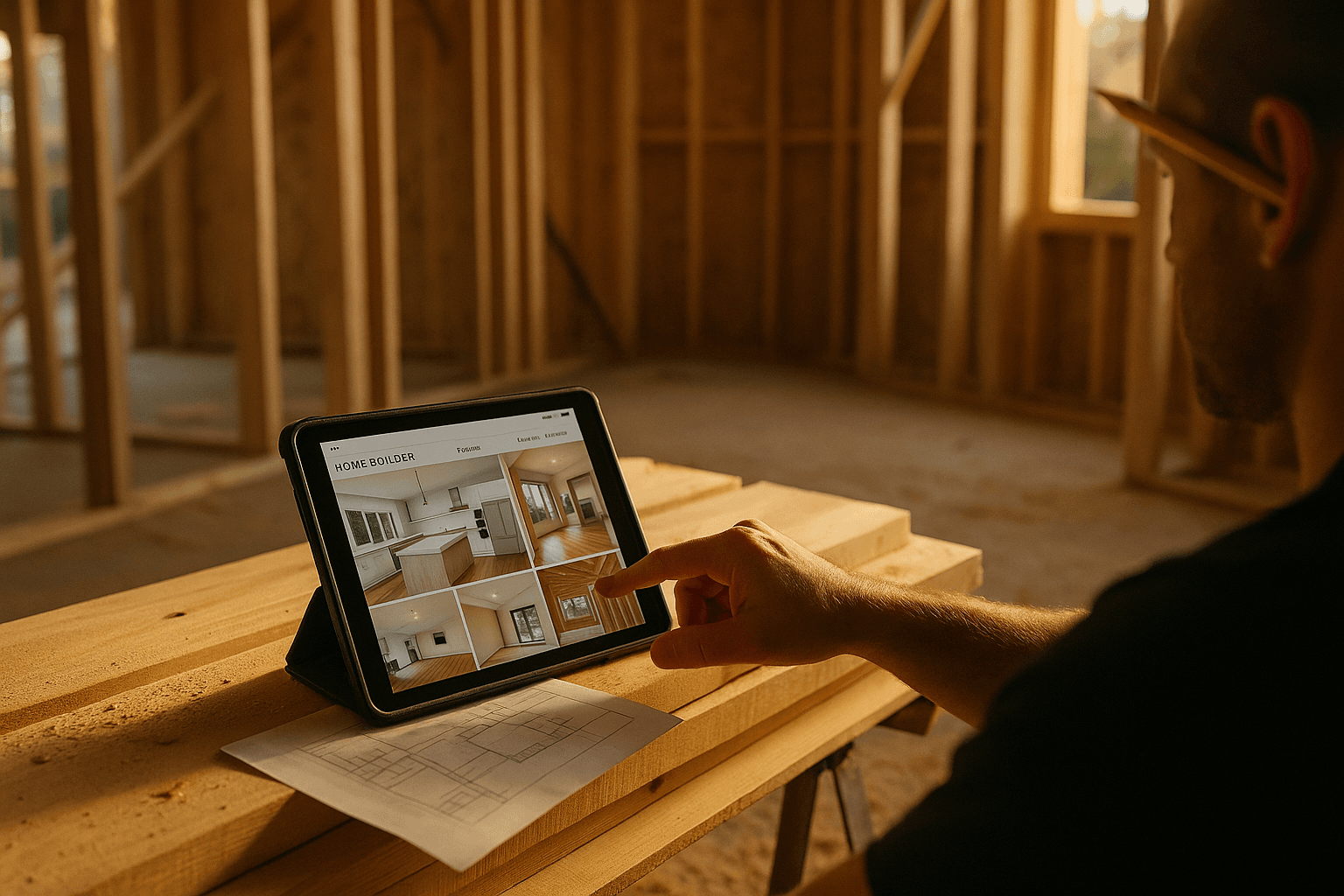
We captured exactly what shows on the first screen of a phone, 390 pixels wide, before any scrolling, and checked two things: does the visible text name the trade or service, and does it name a service area?
Most sites get the first half right. Only 6.4% failed to name their trade (23 of 359). But 33.1% didn't name a suburb, city or region anywhere on that first screen (119 of 359). Tradie work is local. A customer in Frankston needs to know you come to Frankston before they'll ring.
The fix is quick: put your trade and your area in the first line a visitor reads. "Plumber in Geelong and the Surf Coast" beats "Quality you can trust". It's the first thing I check on any tradie site.
Finding 2: half make the customer hunt for the phone number
47.9% of homepages had no tap-to-call link on the first phone screen (172 of 359). 49.3% had no quote or contact form on the homepage at all (177 of 359). Most sites fit a phone screen well enough (87.2% passed our layout check, 313 of 359), so the problem isn't the template. It's what's on it.
Put together, only 23.7% of homepages passed all three basics: clear what and where, tap-to-call up top, and a form (85 of 359). That's the bad site I'd never send ads to.
Finding 3: the code behind the page says little
Structured data helps search engines read what a business is and where it works. 71.9% of catalogue sites we checked carry no LocalBusiness or trade schema (11,823 of 16,438). Nearly a third carry no structured data at all (31.9%, 5,246 of 16,438).
Pages do the same job in plain sight, and they answer my first question: what do you do, and where? Fewer than 1 in 10 homepages link to a page for a specific suburb or area (8.9%, 32 of 359), and fewer than half link to a page for a specific service (45.7%, 164 of 359). We counted homepage links only, so treat both as a floor.
More on this: best website builders for tradies and what a fencing contractor website needs to win jobs.
Finding 4: plenty of sites look like nobody's home
Of the sites showing a copyright year in the footer, 29.0% still say 2024 or earlier (2,952 of 10,189) and 11.4% say 2020 or earlier (1,163 of 10,189). A stale year isn't a crime, but a customer comparing three quotes notices it, and it's usually a sign the services, photos and suburbs haven't been touched either. A site that looks like nobody's minding it is the kind of bad site I'd never send ads to.
The basics still trip some sites up: 4.2% had no working HTTPS (725 of 17,398), so browsers warn visitors before they reach the phone number, and 3.8% returned an error page when we checked (660 of 17,523).
Finding 5: five-star work, eleven reviews
86.1% of rated businesses sit at 4.5 stars or better (18,620 of 21,616). But the median business has 11 Google reviews, nearly half have fewer than 10 (47.5%, 10,095 of 21,253), and only 17.9% have 50 or more (3,803 of 21,253). Among the 4.5-star-plus businesses, 44.8% have fewer than 10 reviews (8,117 of 18,125).
A customer comparing two tradies sees the count next to the stars. Most of the work at the trade business I ran came from word of mouth; a Google review is word of mouth a stranger can read.
Finding 6: about 3 in 10 have no website at all
8,652 of the 27,331 businesses in the catalogue had no website listed on their Google profile (31.7%). We checked whether that was a gap in our collection: we took 200 of those businesses at random and looked for a website under their business name. We found a matching site for 11 of them. Our lookup method finds about 6 in 10 known sites (121 of 200 tested), so we corrected for what it would miss. That puts the true no-website share at an estimated 28.8%, about 3 in 10 (95% range 26.6% to 30.0%). By trade we only have the uncorrected catalogue share, which runs a little high: carpenters (49.8% of 2,705) and handymen (49.2% of 3,374) are highest, solar installers (13.5% of 2,725) lowest.
Most of the work at the trade business I ran came from referrals. A referral gets someone to look you up. If they find nothing, they can't tell what you do or where.
What to do this week: don't send ads to a bad site
The biggest waste I see online is ads sent to a bad site. You pay for the click, the customer lands, can't tell where you work or can't find the number, and goes back to Google. Fix the basics first, then spend.
Seven questions, ten minutes, on your own phone. Fix every "no" on the first five before you spend on ads:
- What and where. Does the first screen name your trade and your area? If not, rewrite the first line.
- Tap to call. Is there a phone number you can tap without scrolling? If not, add one to the header.
- Ask for a quote. Is there a short quote form on the homepage? If not, add one with three or four fields.
- Looks current. Does the footer say this year? If not, what else hasn't been updated?
- HTTPS. Open your site with https:// in front. If the browser warns you, ask your host to fix the certificate.
- Reviews. Under 20 Google reviews? Text your review link to your last five happy customers today. Turn every referral into a review.
- Pages. Does each main service and suburb have its own page? If not, start with the three jobs you want more of and the three suburbs you want more work in.
If you'd rather we built it, here's how our websites for tradies work. Or run your own site through the free website scorecard.
Get the full report. The designed Tradie Website Index 2026 has every chapter, the playbook, and results by trade and state. Download the full report.
Keep going: great service business website in 2026 or why tradies need professional websites.
Method
- Catalogue: 27,331 Australian trade businesses with a Google Maps listing, across all eight states and territories, collected 13 August to 8 November 2026 from Google Maps listings and the businesses' own websites. It is a catalogue of listed businesses, not a census of every trade business.
- Exclusions: listings whose Google category didn't match the trade, domains on spam-prone extensions, and phone numbers shared across multiple brands.
- Skew: handyman (3,374), solar (2,725), carpenter (2,705), tiler (2,527) and fencing (2,433) make up a larger share of the catalogue than plumbers (1,133) and electricians (1,055). By state, VIC (6,836) and NSW (5,234) are largest and NT (871) smallest; 377 rows have no state. Instead of topping trades up, we checked the headline rates weighting each of the 13 largest trades equally. Every catalogue rate moved by 2 points or less (for example, no-schema 73.3% weighted vs 71.9% raw; fewer than 10 reviews 49.5% vs 47.5%). The phone scan draws from the catalogue too; weighted the same way, its three-basics fail rate is 79.1% against 76.3% raw (trade subsamples are small).
- Bases: every percentage uses only the businesses where that field could be measured, and states its base, which is why bases differ (21,616 have a rating; 21,253 have a readable review count).
- Phone scan: 458 catalogue websites drawn at random, loaded in a headless browser at 390×844 pixels between 8 and 9 November 2026. 374 loaded; 359 were live trade sites (parked and placeholder pages excluded). The 84 that didn't load are excluded; slow or broken sites likely fail the basics too, so the fail rate is more likely understated. Margin of error up to ±5.2 points at 95% confidence, for websites in the catalogue; it doesn't extend to all Australian tradie sites.
- "What and where" check: an AI classifier read the visible first-screen text. We hand-labelled 100 homepages without seeing its answers; it agreed with us on 95 of 100.
- No-website spot-check: 200 random no-website rows; site lookup by business name, with the lookup's hit rate measured on 200 businesses whose website we already knew (121 of 200).
- Not included: page-speed scores. We couldn't run Google's PageSpeed test at scale for this edition, so we've left speed out rather than publish a weaker measure.
- No business in the dataset is named. Pat Fong, the author, ran a trade business and now builds websites for trade businesses at ServiceScale.
FREE REPORT · TRADIE WEBSITE INDEX 2026
Get the full Tradie Website Index 2026 report.
Seven chapters including the playbook, plus results by trade and state. 27,331 businesses catalogued, 359 homepages tested on a phone. Free 15-page PDF.
Related guides